But I just got situated…
For one young man, coming home from college was always stressful. The moment he got home he no longer wanted to do any chores, maintain his hygiene, pick up after himself or act like the adult he was at college. He believed that since he was home, he didn’t have to do any of that, so he didn’t. As time went on, the young man began to smell, the house and his room was dirty and unorganized, and all of those life skills he learned while away at college began to fade.

The young man’s parents decided to let their son be because he was on break, yet this caused their own break to become difficult as well. They were constantly cleaning up after their son, dealing with his emotional outburst due to being told to do chores, and more, so they were unable to relax as well. Yet, despite thinking everything would go back to normal come January, the young man returned to college before immediately wanting to drop out, claiming “independent life was just too difficult.”

This is when the parents reach out to the College Life Skills Program for help. There they ensured that the young man would regain his skills before trying to keep them during breaks by utilizing a planner, keeping a chore sheet with his parents, and setting timers to remind him to do chores/shower. As the young man continued this, they realized they had more time for actives, family time, and relaxing during break, causing what was once a negative event to become a positive one.

Winter break can be stressful not just for the parents, but for kids too. Whether they are college aged or in kindergarten, the long winter break can cause stress for them. It can;

  • Completely disrupt their routine
  • Cause them stress/anxiety because of the change
  • Isolation due to stressors/missing their peers
  • Not wanting to return to school
  • Not maintaining their skills, they have achieved (Washing their own laundry, doing the dishes, cleaning their room, etc.).
  • Not maintaining their hygiene because they feel as if they don’t have to at home
  • Emotional outburst/fighting with their siblings
  • And more!

All of these factors can cause the both the child and parents stress, depression, isolation, avoidant behaviors, and overall make what is supposed to be a great experience a difficult one. However, there are skills that can be learned to avoid this.

  • Preparing them before break/coming home
  • Maintaining a schedule that worked for them (Eating, getting up, showing, etc., all at the same time still).
  • Breathing exercises can help when trying to deescalate a situation as well as with emotional support
  • Utilizing a calendar/planner so they know what the weeks ahead are like.
  • Ensuing they are still receiving enough peer interaction
  • Communication skills to ensure they are advocating for themselves and voicing what they need.
  • Actively ensuring they are managing their time properly.
  • Not allowing them to spend too much time on devices
  • And more!

Children, teens, and young adults can begin to lose those skills once coming back from school, causing the cycle of stress to repeat once they have to go back, but the Support for Students Growth Center and College Life Skills Program can help ensure that pattern breaks.

At the Support for Students Growth Center, we provide social, behavioral, educational, emotional, and executive functioning skills services children, teens, young adults, and their families, who may be Neurodivergent or not need for a happy and successful life in and out of school settings. Our team of professionals offers individualized and family coaching/counseling and social skills groups to help teach skills such as how to remain productive during winter break to ensure parents do not have to worry that their kids will be unable to make and maintain a functioning independent life on their own. So, if your child is struggling with skills like the ones listed above and much more, the SSGC is equipped with the tools to help.

Click here and call now to schedule your FREE 20-minute individualized screening


Dr. Eric J. Nach, Ph.D., M.Ed., A.S.D.C., is a Developmental and Behavioral Specialist who specializes in Autism, ADHD and related disorders. Dr. Nach is the founder of the Support for Students Growth Center and College Life Skills Program where he and his team of professional’s help develop the Emotional Maturity, Executive Functioning, Life Skill and Social Abilities of children, teens, young adults and college students and those high school students preparing for college.
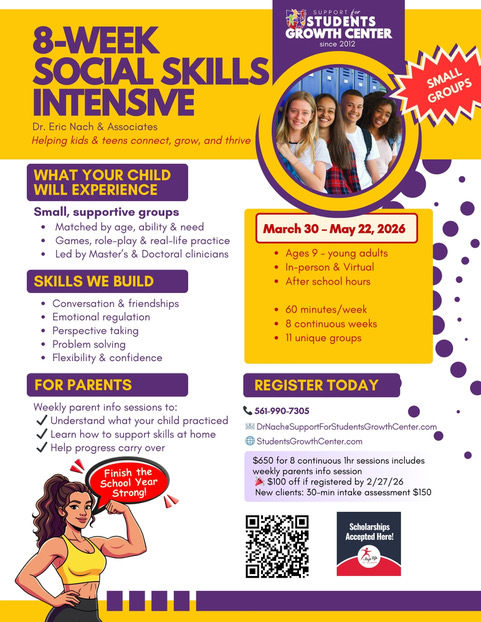

8-Week Social Skills Intensive-Version 3

I didn’t mean it; I am just so stressed out…

For one young woman, controlling her emotions has never been easy. As a child, she would lose her temper whenever someone wouldn’t want to play with her, or the family ate something she didn’t want that day. Then, as she got older, she thought that her ability to handle her emotions would change, when in reality, only the stressors did. She would find socializing, getting all of her schoolwork done, going to work, and interacting with others stressful, so when something didn’t go her way, she would lash out.

When she was younger, she would hit, scream, and have melt downs, and as she got older, she would shut down, exhibit avoidance behaviors, refuse to get a job and become independent, and more all because she couldn’t emotionally regulate and control her behavior. Even when she did move out, her inability to react in an age-appropriate way caused her relationships with her roommates to become strained before disintegrating completely.

This then led to the young woman to start what felt like an endless cycle of becoming independent and moving out before being unable to regulation her behavior and emotions on her own and ending back at square one to start again until her and her family realized there needs to be a change.

Do you too, see a need for change?
Does your child…

  • Have a meltdown at a small inconvenience?
  • Withdraw socially?
  • Fidget in appropriate ways/times (ex: Yelling out in class, playing with loud toys, etc.)?
  • Lash out often (physically and emotionally) (screaming, hitting, etc.)?
  • Speak poorly about themselves?
  • Exhibit avoidance behaviors?
  • Show a risk for Failure to Launch or is currently experiencing it?
  • And more?

Well, at the Support for Students Growth Center we can help by…

  • Teaching them breathing and other calming techniques in moments they may find it hard to relax
  • Techniques to avoid physical and verbal lashing out
  • Ways to help them advocate form themselves that is not only beneficial for them mentally but is effective for every party involved.
  • How to deal with the other things in life that may be adding onto the stress causing them to lash out.
  • How to continue to use these techniques every day/as often as needed
  • How to prevent outburst, and if they do happen, how to deal with them appropriately afterwards
  • And more!

At the Support for Students Growth Center, we provide social, behavioral, educational, emotional, and executive functioning skills services children, teens, young adults, and their families, who may be Neurodivergent or not need for a happy and successful life in and out of school settings. Our team of professionals offers individualized and family coaching/counseling and social skills groups to help teach skills such as how to remain organized to ensure parents do not have to worry that their kids will be unable to make and maintain a functioning independent life on their own. So, if your child is struggling with skills like the ones listed above and much more, the SSGC is equipped with the tools to help.

Click here and call now to schedule your FREE 20-minute individualized screening


Dr. Eric J. NachPh.D., M.Ed., A.S.D.C., is a Developmental and Behavioral Specialist who specializes in Autism, ADHD and related disorders. Dr. Nach is the founder of the Support for Students Growth Center and College Life Skills Program where he and his team of professional’s help develop the Emotional Maturity, Executive Functioning, Life Skill and Social Abilities of children, teens, young adults and college students and those high school students preparing for college.

But what if they don’t like me…

As the school year starts to settle and students are found their friend groups; socializing can be made exceptionally harder for some students. They may feel as if no one wants to socialize with them now because they all have their own friends or that they waited too long to make friends. This can then discourage them from making friends at all, which may lead to isolation and an unhappy school life.

Friends help make school fun. They help encourage us when an assignment or task may be too hard, work on projects with us, hang out with us at lunch and after school, and are a companion to help us through life. Without them, school can feel scary. Kids can feel like they are alone, leading them to lack self-advocacy skills and hold all their negative emotions inside.

This can then lead to emotional outburst, causing them to become even more socially isolated since almost no one wants to hang out with someone who screams at them all the time. They may then try to avoid school all together, causing their grades to also slip, and if they do not work on these skills now, these issues will follow them into adulthood, causing them to become at risk for “failure to launch.” However, the Support for Students Growth Center had the tools to help with that.

 At the Support for Students Growth Center, we offer social, behavioral, educational, emotional, and executive functioning skills services children, teens, young adults, and their families, who may be Neurodivergent or not need for a happy and successful life in and out of school settings. Our team of professionals offers individualized and family coaching/counseling and social skills groups to help teach skills such as how to socialize to ensure parents do not have
to worry that their kids will be unable to make and maintain a functioning independent life on their own. So, if your child is struggling with skills like the ones listed above and much more, the SSGC is equipped with the tools to help.

Schedule your FREE 15-minute individualized screening

Dr. Eric J. Nach, Ph.D., M.Ed., A.S.D.C., is a Developmental and Behavioral Specialist who specializes in Autism, ADHD and related disorders. Dr. Nach is the founder of the Support for Students Growth Center and College Life Skills Program where he and his team of professional’s help develop the Emotional Maturity, Executive Functioning, Life Skill and Social Abilities of children, teens, young adults and college students and those high school students preparing for college.

But I just can’t do it all…

Managing life is hard. Keeping up with schoolwork, chores, extracurricular activities, and a social life can be stressful for children, teens, and young adults. They may find that completing a task so they can go out with their friends to be too daunting, or school itself to be too demanding when paired with at home responsibilities. This can then cause them to exhibit avoidance behaviors. They may spend more time doing a homework assignment, so they don’t have to clean their room, or simply just avoid the task all together because it is too overwhelming. They may also find it hard to figure out how not only to start a task, but how to follow through and finish a it, or simply manage the task itself, which is where our executive functioning skills come in.

Executive functioning skills help us manage these tasks and our environment in a way that makes us feel confident in our ability to complete things rather than just feeling anxious or stressed out by it. Managing your time so you don’t feel rushed, keeping an organized space to minimize stress, being able to not only begin a task, but finish it, using a planner to keep track of your time, and so much more are all executive functioning skills and techniques that we need in order to be successful in life. If we do not have age-appropriate skills, then everyday life can become stressful. We may feel as if we always have too much to do and never enough time to do it, but if you have strong executive functioning skills, not only completing the task at hand, but completing it well will be much easier. This can then also prevent anxiety, emotional regulation issues, and avoidance behaviors that can prevent them from reaching their fullest potential in life, and the Support for Students Growth Center is equip with the tools needed to help them develop these much-needed skills.

At SSGC, we provide the social, behavioral, educational, emotional, and executive functioning skills children, teens, young adults, and their families need for a happy and successful life in and out of school settings. Our team of professionals offers individualized and family coaching/counseling and social skills groups to help teach skills such as how use their executive functioning skills to ensure parents do not have to worry that their kids will be unable to make and maintain a wonderful life on their own. So, if your child is struggling with skills like the ones listed above and much more, the SSGC is equipped with the experience and tools to help.

Click here and call now to schedule your FREE 20-minute individualized screening


Dr. Eric J. Nach, Ph.D., M.Ed., A.S.D.C., is a Developmental and Behavioral Specialist who specializes in Autism, ADHD and related disorders. Dr. Nach is the founder of the Support for Students Growth Center and College Life Skills Program where he and his team of professional’s help develop the Emotional Maturity, Executive Functioning, Life Skill and Social Abilities of children, teens, young adults and college students and those high school students preparing for college.