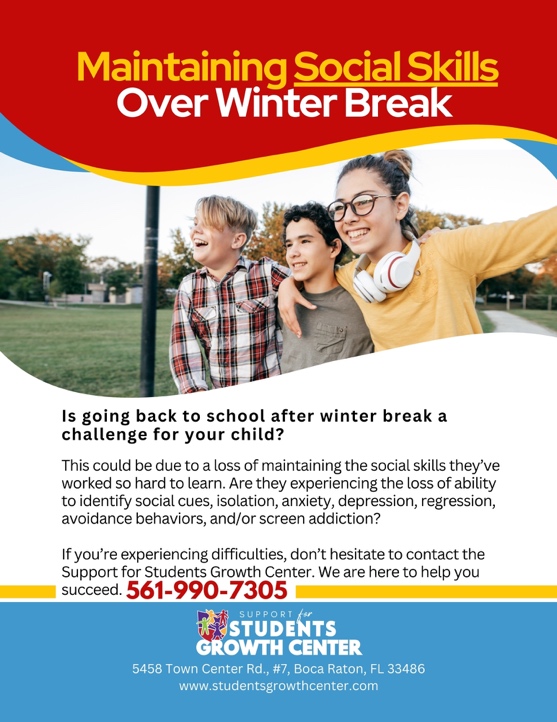
Maintaining Social Skills Over Break
I don’t want to share!
For one young boy, coming back from winter break was always difficult for him to handle. After working for months on his social skills, staying home for weeks before having to go back to school was stressful since he often had a hard time remembering what certain facial and body languages mean since he didn’t have to identify them at home.
He also did not want to share his new toys with the other kids, have them be in his space, touch him, or overall socialize because over the break, he did not have to. Instead of maintaining and continuing to utilize and practice his social skills, he locked himself in his room with all of his new toys before refusing to play with his siblings and other family because when he tried, he found that he often had a hard time communicating his emotions. Doing so made the boy feel like even when he tried, he did not like having to socialize because it was too hard to remember it all, which was overwhelming for him, so when it was time for him to return to school, he had a breakdown.
He was screaming, crying, destroying his room and his sibling’s room, and more, so he would not have to go back to school. As his parents realized he needed extra aid, they reached out to the Support for Students Growth Center for help. There, they attended social skills classes to help ensure their son was actively practicing the skills he learned to ensure not to lose them like he often did during breaks. The parents also attended support sessions of their own, meeting to discuss issues and techniques for them as well to help support not only their son, but their entire family.
The boy learned to identify the situation he is in before applying the correct social skills to help ease his anxiety. After being able to identify and communicate both his and others’ emotions, he was then able to adapt to the situation, making socializing much easier and even a happy experience for the boy as his friendship group began to grow.
Not practicing social skills during breaks can cause
- Them to lose their skills to be able to identify things in social situations
- Them to become isolated, anxious, and/or depressed
- Regression
- Avoidance behaviors
- Failure to launch
- Screen addiction
- And more
We can combat this by
- Actively practicing social skills while on break and at home
- Setting up playdates/social times
- Monitoring screen time
- Taking them to social skills classes
- And more, that we can help with!
At the Support for Students Growth Center, we provide social, behavioral, educational, emotional, and executive functioning skills services children, teens, young adults, and their families, who may be Neurodivergent or not need for a happy and successful life in and out of school settings. Our team of professionals offers individualized and family coaching/counseling and social skills groups to help teach skills such as how to maintain social skills during breaks to ensure parents do not have to worry that their kids will be unable to make and maintain a functioning independent life on their own. So, if your child is struggling with skills like the ones listed above and much more, the SSGC is equipped with the tools to help.
Click here and call now to schedule your FREE 20-minute individualized screening
Dr. Eric J. Nach, Ph.D., M.Ed., A.S.D.C., is a Developmental and Behavioral Specialist who specializes in Autism, ADHD and related disorders. Dr. Nach is the founder of the Support for Students Growth Center and College Life Skills Program where he and his team of professional’s help develop the Emotional Maturity, Executive Functioning, Life Skill and Social Abilities of children, teens, young adults and college students and those high school students preparing for college.