Making the transition from elementary to middle school is a colossal milestone for all children and their parents. For “our children” on the autism spectrum, with ADHD, or other developmental “abilities” this dramatic change of life is even more traumatic than for their NT (neuro-typical) peers. We have found the expectations of middle school teachers to be very different and considerably more intense than that of their elementary school counterparts. In our experience with helping incoming 6th graders make the transition to the secondary school way of life many factors play a vital role in student success and happiness (and of course the serenity of parents).

The primary goal of the middle school teacher is to help all of their students become ready to be successful in high school and beyond. Middle school teachers expect all students to be functioning at a higher level of independence than they did in primary (elementary) school. We have found that the teachers who tend to be most successful with helping “our children” transition to middle school are very aware that our new 6th graders are still operating on a 5th grade elementary school level or below, emotionally, socially, and possibly academically. These students need direct instruction on how to function in a middle school campus. Issues to be considered include; organization, self-advocacy, conflict management, socialization and following new routines. Just making the transition to more classes and being with many more students and teachers will take a considerable amount of planning, dedication and effort by everyone involved, i.e., parents, teachers, administrators, support staff, and of course the children themselves. Looking ahead, the high school teachers “our children” will have are even more content driven, as they are focused on delivering content knowledge on particular subjects to help the students obtain mastery and have to adjust to many of the same transitioning issues as middle school teachers.

Many of “our children” are “visual learners” and benefit by being shown what organization looks like in a specific setting. They need to be shown how to maintain and utilize their materials, including their personal office (their backpack). Their backpacks are often affectionately referred to as “the black hole” because many times, school work and other materials that go into the backpack mysteriously disappear. “Our children” need to learn how to navigate from one class to another, how to navigate the lunch room, how to enter and exit the school campus, how to find and use the busses or parent pick-up line for those children not taking busses, how to be successful in P.E. and even the procedures for using the restrooms. They need “authentic” life training and experiences to see how to be successful. They must utilize many social, emotional, and academic skills regarding interacting with peers, teachers and others, in addition to knowing what a completed homework assignment looks like, what successful note taking, class work, and homework looks like, and how to deal with a break in routine, conflicts, and how to study for and complete tests successfully.

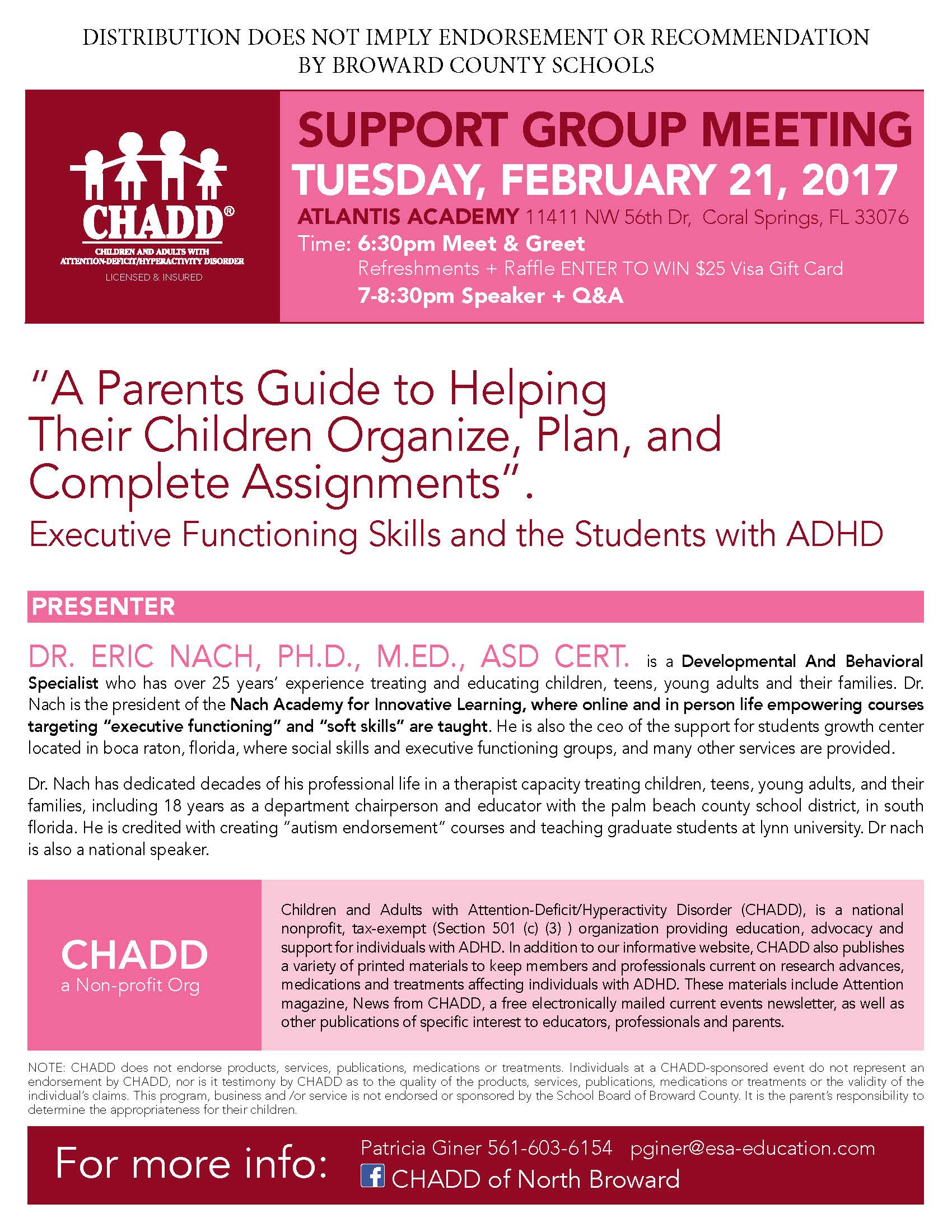
Dr. Eric Nach, Ph.D., M.Ed., A.S.D. Cert., is a Developmental and Behavioral Specialist and the President of the Support for Students Growth Center in Boca Raton, FL

Course Run Monday’s-Thursday’s 4:00pm – 6:00pm

Unique program being offered at the “Support for Students Growth Center” of Boca Raton. We will offer our professionally created and delivered, proprietary, interactive hi-tech infused “Middle School, High School, and College Readiness Program” program for students 13 years old until college aged.

Cost: $495 per week


Sessions

Session 1 Session 2
July 31 – August 3 August 7 – August 10


Series 1

Goal setting and task completion
Attention management
Problem solving techniques
Organizational skills
Working in groups
Flexibility and adaptability

Series 2

Time Management
Managing anxiety in and out of school
Following directions
Advocacy skills
Responsible use of technology

Course Composition

Professionally prepared, proprietary curriculum, delivered as an interactive hi-tech infused, workshop/class type setting featuring;

  • Student workbooks
  • Each course designed into easy to follow modules
  • Small group instruction
  • Clear course objectives
  • Ongoing comprehension checks
  • Hands-on activities
  • Quick reference guides
  • Relevant case studies for each module
  • Problem solving activities for each module geared toward application of skills to school, home, and career setting to increase likelihood of generalization of skills.

Summer Services 2017-3

Summer Science and Art Camp 2017

camp spring break

Science and Social Skill Summer Camp

Our program is designed for children and teens between the ages of 5-14, who are “mainstreamed” and would benefit from a small intensive science experiences, technology infused, and social skills-based camp experience in Boca Raton. (Interview required, camp limited to 12 students each week)

We are an approved PLSA Provider

Sessions

June 2016 July 2016 August 2016
Session 1: June 5-19 Session 5: July 10-14 Session 9: August 7-11
Session 2: June 12-16 Session 6: July 17-21
Session 3: June 19-23 Session 7: July 24-28
Session 4: June 26-30  Session 8: July 31-4 **No camp the week of July 4th

Sample Summer Camp Schedule

Time Activity
8:00-9:15 Drop off
8:00-9:40 Group Free Play
9:40-10:00 Focusing activity (stretch, yoga, breathing exercise)
10:00-11:00 Technology infusion/Team building/Science Experiences
11:00-11:15 Snack Time
11:15-12:00 Social Skills activity
12:00-12:30 Lunch
12:30 1:00 Music therapy/board games
1:00-1:45 Science Experiences
1:45-2:15 Snack, Quiet time (reading time, group play)
2:15-2:30 Wrap-up/Review
2:30-3:30 Group Play, Art, Music, Board Games, Reading
3:30-4:00 Parent pick-up*

Cost: $495 per week

*10% Deposit due by May 1

*Final payment due 2 weeks before each session


Community Based Instruction

-Bowling

-Lunch

-Mall Outings

-Boca Police Department

-Boca Fire Department

Fun science experiences daily!

Children who may be on the autism spectrum, have ADHD, or sensory issues may become overwhelmed by family gatherings and activities that come with the celebration of the “holiday season”.  The daily routine, so important to many of “our children”, is broken and the inability to “predict” what events will play out in a day can lead to behavior issues. Holiday decorations, lights, music, smells, foods, unfamiliar pets, loud conversations, cigarette smoke, perfume, hugs, and having strange people around are not exactly normal to their routine.  When you look at it all through “our child’s” eyes, it is understandable that they may struggle with the events of the holidays.

When preparing “our children” for the unpredictability of the holiday season, you want to start preparing them early and to practice for the new or out of the ordinary social experiences. I have been asked to  provide parents with a brief overview of some of the therapy-based options, family-oriented ideas, and travel suggestions that you can implement when preparing your child for holiday festivities.  To follow is a partial list of ideas to consider and follow with fidelity that are sure to make this holiday season, a wonderful time for all.

Therapeutic Options

  • Social stories can help prepare your child for any new or uncomfortable event. Find stories (using the internet, via books, or from professionals) that cover how to act during holiday activities such as parties, being around unfamiliar people and large dinner gatherings, or write your own personalized social stories (be sure to keep ALL of the verbiage positive).  These stories allow your child to visualize the out of the ordinary situations and see them in a positive light.
  • Behavioral therapy can help your child deal with the behavior problems created by their perceptions and emotions.
  • Your child may benefit from therapeutic social skills groups.  Children are encouraged to practice social situations with their peers (through role playing and modeling) as they are being taught by professional therapists how to generalize solutions to perceptual changes.
  • It is not recommended to make medication changes during the holiday season, unless you are given specific directions to do so from your child’s providing physician. We want our children to remain as balanced as possible during the holiday season.

Family-based Ideas

  • Make sure your child’s favorite foods and activities are included in the celebrations.  Any time you can add in their special interests or some of their limited favorite foods, you will increase their comfort level and the enjoyment of everyone around.
  • A.L.T. Take precautions to minimize the chances that your child is (H) hungry, (A) angry, (L) lonely, or (T) tired. Any of these conditions by themselves is enough to heighten sensitivity and impair your child’s perception, which will impact everyone they come in contact with.
  • For those holidays where gift giving is the norm, inform gift givers of your child’s specific interests and dislikes. If possible, parents can help other gift givers make appropriate gift choices. Some of “our children” are sensory sensitive to the texture and/or sound of items, whereas others are emotionally sensitive and will “react” poorly if they perceive they are being given a gift appropriate for a much younger child. Receiving unwanted items may even lead to a meltdown.
  • Have an alternate plan for times where sensory issues become a problem. Anything from a quiet place to regroup or calm down, to planning to stay for only part of the time of the event, may be necessary.
  • Virtually any parent who has a child with “perceptual and or “social challenges” knows the value of having not only “Plan A” and “Plan B”, but, “Plan C, D, E, and F”.
  • Set your child up with a “buddy” during holiday festivities, the “buddy” can be a responsible sibling, cousin, or adult. Parents need to know the child is safe and hopefully enjoying themselves, while parents and others are entitled to a stress-free (or at least, reduced stress) holiday season.

Ideas for Traveling

  • Parents would be wise to research the location the family is going and the means of transportation being taken to get there. Fortunately, today, many facilities and organizations understand about the “special needs” some of our children have.
  • If your child has sensory issues such as sensitivity to noise, smell, touch, or lighting, see if you can reserve accommodation that are less stimulating to your child. Sunglasses, a hat, and earplugs may also be beneficial.
  • If you are traveling by plane, ship, or train, you can inform the agency of the needs your child may experience and provide them with a “heads-up” of potential issues. Once again having “Plan A, B, C, and D” in place should greatly increase the level of holiday enjoyment for everyone involved.
  • When sensory issues are involved, it can be worth bringing along your child’s normal bed sheets and pillows in case they find those in a hotel unpleasant. Any new clothes for the trip may need to washed several times if your child finds these ‘scratchy’ on the skin.
  • The use of electronics (with headphones) has proven to be helpful to help “our children” so they become distracted from overly stimulating situations and have a method to relax.
  • Some of our children are extremely comfortable on airplane’s, some are not. If your child has the potential to struggle with being confined on an airplane for hours, you may want to consider different options. You do have the option of boarding first, choosing special diets, and optimal seating. Service animals may also be an option for your family.

There are parent support groups and therapeutic service providers who can serve as valuable assets to having a wonderful holiday season. Don’t just leave this to chance, prepare and you will be rewarded.


Dr. Eric Nach, PhD, MEd, ASDc

Our program is designed for children and teens between the ages of 5-14, who are “mainstreamed” and would benefit from a small intensive therapeutic social skills based camp experience in Boca Raton.

Develop those skills needed for a lifetime of happiness and productivity in a safe and exciting “camp” setting.

Sessions

Session 1 Session 2 Fee
December 26-30 January 2-6 $495 per week (discounts for siblings)

We are an approved Gardiner (PLSA) Provider

Sample Schedule

Time Activity
8:30-9:15 Camper drop-off
8:30-9:40 Group Free Play
9:40-10:00 Focusing activity (stretch, yoga, breathing exercise)
10:00-11:00 Art therapy/Team building
11:00-11:15 Snack Time
11:15-12:00 Social Skills activity
12:00-12:30 Lunch
12:30 1:00 Music therapy/board games/
1:00-1:45 Sensory activity, movement activity
1:45-2:15 Snack, Quiet time (reading time, group play)
2:15-2:30 Wrap-up/Review
2:30-3:30 Group Play, Art, Music, Board Games, Reading
3:30-4:00 Parent pick-up*

Scheduling Your Time 

Your time is valuable, so you should treat it that way. Your schedule can get busy and sometimes it can seem like there are not enough hours in the day. But when that happens, we just need to take a step back, and manage our time effectively. When we schedule our time and resources in a way that benefits us and aides in becoming better organized, there’s nothing we can’t accomplish, because, “The Sky’s The Limit”.

Have a Master Calendar

It can seem like a good idea to have several calendars for every area of life, but when you use more than one at a time, it’s easy to get them confused. With multiple calendars, you can run the risk of double booking events or miss important appointments. Instead, get one calendar and put it somewhere you can see it every day, such as in your technology, on the refrigerator or hanging by the front door. Write all of your personal, school, and work reminders on it, including deadline dates, appointments, events, tests, and reminders. When you use one calendar for everything you do, you are not only able to manage your time better, but you can get rid of the paper reminders you have posted everywhere.

Use Technology

Cozi is one example of a free “app” that can be used by individual or families to coordinate daily events and things to-do. Complete with an automatic “sync” function to Apple© products, Cozi© is a real-time calendar, to-do-list, shopping list, and journal. 

Setting Deadlines

When scheduling our time, deadlines provide a sense of structure and balance for us. While every person responds to deadlines differently, they are a key tool to better time management. By setting deadlines, you are putting a concrete need in your schedule, and it helps prevent it from being forgotten or lost in the near future. They give us a sense of accountability when it comes to things we either want or need to get done. So whether you write them on a calendar or program them into a mobile device, the next time you plan to do something, set yourself a deadline first and stick to it. You’ll find that when you take the time to schedule them, you are more likely to make time for other things.

Tips when setting deadlines:

Keep your deadlines in arm’s reach – write them down where you will see them

Set periodic reminders – give yourself reminders that a deadline approaches

Pad your actual deadline a little – give yourself some extra wiggle room

Remove or Limit the Time Wasters

A time waster is something that can distract you or take away from the task at hand. They can occur at home, school, or at work. Removing or even limiting some of these wasters can improve your concentration and help you stay focused on what you want or need to do. They can include personal time wasters, such as excessive; checking messages, texting, social media, searching the web, or watching videos, or can even be as simple as wasting extra time to go look for that extra pencil. Practice cutting or limiting one thing that distracts you the most. Give yourself a set time that you will not let these things distract you or take away from your current responsibilities. You’ll be amazed how taking these small steps will improve your time management.

Some common time wasters and distractions:

• Excessively checking email/text/phone messages

• Social media

• Boredom or daydreams

• Extra time spent away from your work area

• Extra time spent looking for things

• Taking on extra projects

Coping with Things Outside of Your Control

There are many things in life that we cannot control, such as an illness, rude or mean people, and especially the weather. But we learn to cope with them every day and adapt ourselves to them. You can control how you react to certain circumstances and setbacks. When we are faced with something we realize we cannot change or control, the key to dealing with it is to, first, accept it. Once you have accepted that you cannot change the fact that it rained on your beach day or that someone almost rear ended you in traffic, we can learn to cope with them by remembering what we can control. You can control what alternative plan you have for beach day and you can control how you choose to respond to the rude driver. Focusing on what you can control rather than what you can’t will help you feel more empowered and less likely to let other obstacles overcome you.

Excerpt taken from the “Organization Skills for High School, College, and Career Readiness” course offered at the Support for Students Growth Center in Boca Raton, Florida.

https://www.supportforstudentsgrowthcenter.com/high-school-college-and-career-readiness-program/